


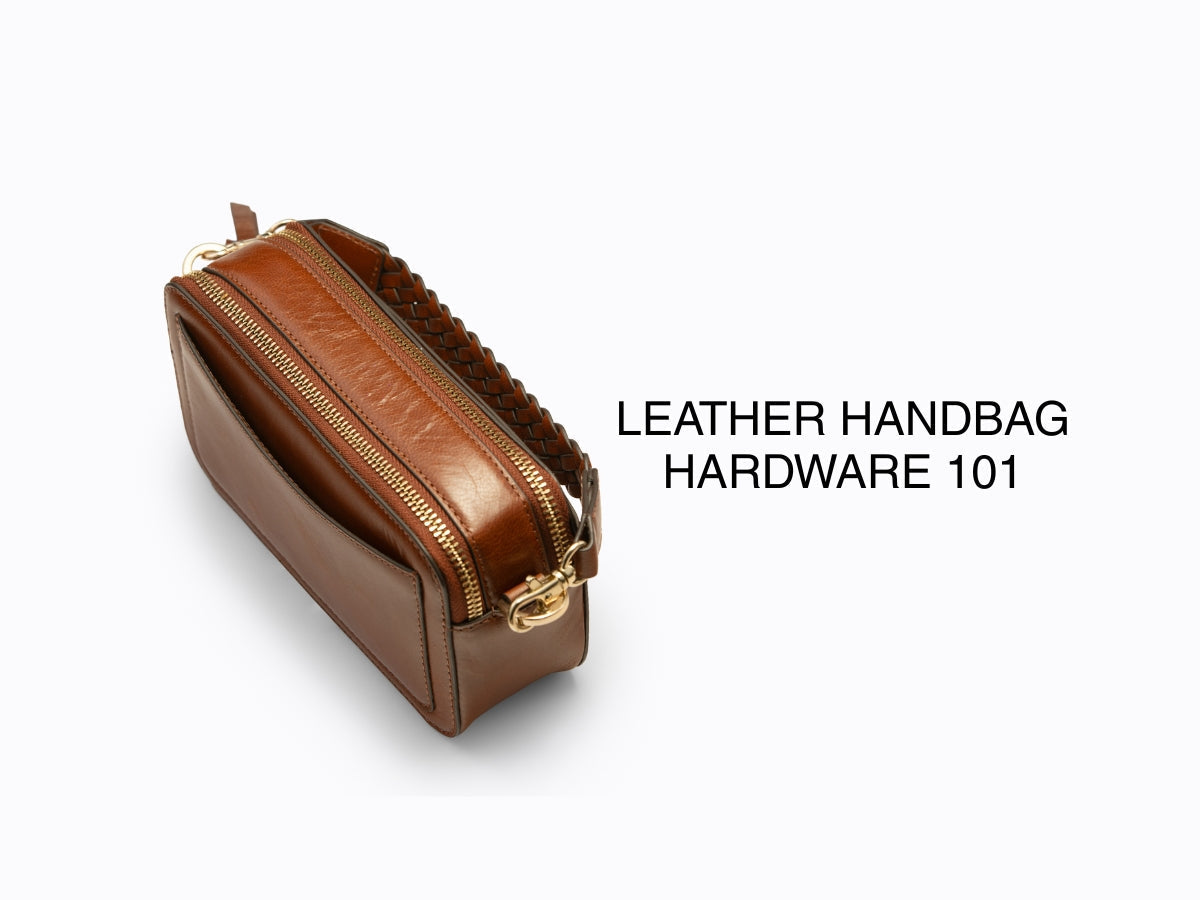
Leather Handbag Hardware 101: Zippers, Clasps, And What They Say About Quality
Quality handbag hardware should feel sturdy, move smoothly, resist wear, and suit the bag's construction. Zippers, clasps, and buckles matter as much as the leather when judging how a bag will perform and age.
When shopping for a leather handbag, most attention goes to the leather itself. The texture, the grain, the way it feels in hand. Stitching and lining often get a second look too, and rightly so, since these are the details that are easiest to see and touch before you buy.
What gets overlooked far more often is the hardware. Zippers, clasps, buckles, and the small metal fittings that hold everything together do more work than people realize. They are opened and closed hundreds of times, carry the weight of straps and handles, and take on stress that the leather never has to. Cheap or poorly attached hardware can let down an otherwise well-made bag, sometimes years before the leather itself starts to show wear.
Lodis has been making genuine leather handbags since 1965, and small construction details like these have always been part of what separates a bag built to last from one that only looks the part. This guide breaks down the main types of handbag hardware, what to check for when judging quality, and why it matters for how your bag holds up over time.
What Is Handbag Hardware?
In simple terms, handbag hardware is any metal or metal-like fitting attached to the bag, from zippers and clasps to buckles, rings, snap buttons, magnetic closures, rivets, and bag feet.
Hardware generally falls into two categories: functional and decorative. Functional hardware does a job, closing a compartment, connecting a strap, or reinforcing a seam under stress. Decorative hardware is there mainly for appearance, though the line between the two often blurs, since a clasp can be both a closure and a design detail at the same time.
It is easy to think of hardware as an afterthought next to the leather, but it carries real responsibility. It secures your belongings, holds straps and handles in place, helps the bag keep its structure, and shapes the overall look. A handbag can be made from excellent leather and still feel unfinished if the hardware is weak, loose, or poorly attached.
The Most Common Types Of Leather Handbag Hardware
A handbag typically relies on several types of hardware working together, each with its own job to do. Below is a breakdown of the most common types, along with what sets a well-made piece apart from a weak one.
Zippers
Zippers are the most frequently used piece of hardware on a bag, made up of teeth, a slider, a pull, and the tape that holds it all in place. Quality zippers move smoothly, close securely and don't snag or catch. Since zippered compartments tend to open and close constantly, weak zippers are often the first thing to wear out.

Clasps & Turn-Locks
Common on structured bags and flap-style designs, clasps and turn-locks include magnetic closures, snap fasteners, and traditional turn-locks. Good ones engage firmly, open easily, and don't loosen or rattle once the bag is being carried. The Sondra Satchel, for instance, uses a bamboo turn-lock, a small design choice that adds character while still doing the job a good closure should.
Buckles
Buckles show up on adjustable straps and as decorative detailing. They need to be sturdy enough to withstand repeated adjustment without warping or loosening, with a clean finish and a secure connection to the strap.
Rings, Hooks & Strap Connectors
D-rings, O-rings, and swivel hooks connect straps to the body of the bag, and they take on constant movement and weight. A weak connector here can undermine an otherwise well-made handbag, since it's under near-constant load whenever the bag is carried. The Solaris Tote uses gold-tone ring hardware for its handles, a small detail that also holds up the bag's structure.
Rivets, Studs & Bag Feet
Rivets reinforce handles and stress points; bag feet protect the base of structured bags from direct contact with surfaces; and studs can be functional, decorative, or both. Together, these smaller details often say a lot about how much care went into the bag's construction. The Catalina 2.0 Backpack includes gold-tone protective feet on its base, a simple addition that keeps the bag off direct surfaces.
How To Tell If Handbag Hardware Is High Quality
The easiest way to judge hardware isn't by looking at it; it's by handling it. Here's what to check before you decide a piece of hardware is actually well made.
1. Check How It Feels
Solid hardware has weight to it. A zipper pull, clasp, or buckle that feels light or hollow is usually a sign the materials, or the manufacturing, cut a corner somewhere.
2. Test the Movement
Open and close the zippers a few times. Snap the clasps shut. Adjust the buckles. Everything should move smoothly, without sticking, grinding, or wobbling. Hardware that feels stiff or uneven straight out of the store rarely improves with use.
3. Look at the Finish
A consistent, even surface is a good sign. Watch for scratches, rough spots, peeling plating, or color that doesn't quite match across pieces. On its own, finish won't tell you everything, but a poor one is rarely an isolated issue.
4. Examine the Connections
Wherever hardware attaches to the leather, whether it's a ring, hook, buckle, or handle, it should sit firmly with no gap or wobble. Loose connections are one of the clearest signs of hardware that won't last.
5. Consider the Hardware-to-Bag Ratio
Hardware should be proportional to the bag it's on. A heavy structured bag paired with delicate, undersized connectors puts unnecessary strain on those pieces. Well-designed bags account for the whole picture, not just individual components in isolation.
Does Gold, Silver, Or Gunmetal Hardware Mean Better Quality?
It's easy to assume a certain finish signals a certain quality tier, but that's not really how it works. Gold-tone, silver-tone, gunmetal, brass-tone, and antique hardware all appear across a wide spread of quality levels, and none of them guarantees a better-made bag.
What actually separates good hardware from mediocre hardware is what's beneath the surface: the construction, how evenly the finish is applied, how well it resists scratching and wear, and how securely the piece is attached to the leather. A gunmetal buckle made well will always outperform a gold-tone buckle made poorly.
Finish is ultimately a style preference, and different finishes can develop their own look over time depending on how they're built. But that's a separate question from quality. When judging a bag's hardware, it's worth looking past the color and paying attention to how it performs.
Why Does Handbag Hardware Matter For Durability?
Every time a handbag is opened, closed, carried, or adjusted, its hardware is doing some of the heaviest lifting. Zippers take on repeated friction throughout the day. Clasps go through constant opening and closing. Strap hardware bears weight and tension with every wear. Rivets reinforce the spots under the most stress, and bag feet protect the base from direct contact and wear.
It's easy to assume that leather quality alone determines how long a bag will last, but hardware can just as easily become the weak link. A bag with premium leather and a poorly made zipper will often show wear at the zipper first, not the leather.
This is why durability comes down to how well everything works together, not just one component in isolation. Leather, stitching, lining, and hardware all need to hold their own for a bag to genuinely last, and strong hardware is what keeps the rest of that construction from being undermined.
Leather Handbag Hardware Buying Checklist
A quick hands-on check is often all it takes to spot the difference between well-made hardware and hardware that's cutting corners. Before you buy, run through this:
- Zippers: Open and close without resistance or snagging?
- Clasps: Engage firmly and stay closed while the bag is carried?
- Buckles: Stay in place after being adjusted?
- Rings and hooks: Attached tightly, with no visible movement?
- Rivets: Secure, with no looseness at the base?
- Finish: Consistent surface, free of scratches or peeling?
- Edges: Smooth, with nothing rough or sharp?
- Overall feel: Matched to the bag's weight and construction?
- Stress points: Reinforced where handles and straps meet the body?
A bag can look great sitting on a shelf and still fall short in daily use. Testing the hardware directly, rather than trusting it on sight, is the only reliable way to know what you're getting.
How To Care For Handbag Hardware
Hardware care is mostly about avoiding a few common mistakes rather than following an elaborate routine. Keep it away from excessive moisture, and clean it gently with a soft, dry cloth. Skip harsh cleaning products unless the manufacturer has specifically recommended one for that hardware.
Zippers in particular benefit from being kept free of dirt and debris, since that buildup is a common reason they start to stick. If a zipper or clasp ever feels stuck, resist the urge to force it, since that's often how hardware gets damaged rather than repaired. Storing the bag in a dust bag when it's not in use, and avoiding overloading it, also helps protect the hardware over time.
Good hardware rarely gets noticed, and that's usually the point. When zippers glide, clasps click shut with confidence, and connectors stay firmly in place, the bag simply does its job without calling attention to any one part. That's why it's worth looking beyond the leather when judging a handbag's quality. Leather, stitching, lining, and hardware all contribute to how a bag performs and how long it lasts, and overlooking hardware means missing part of the picture.
Since 1965, Lodis has approached genuine leather handbags with that same idea in mind, treating construction as a whole rather than leather alone. The next time you're evaluating a bag, give the hardware the same attention you'd give the leather. It often tells you just as much.
Frequently Asked Questions
Q1. What is handbag hardware?
Handbag hardware is basically all the metal bits on a bag, zippers, clasps, buckles, rings, rivets, that sort of thing. Some of it's just for looks, but most of it is doing actual work every time you use the bag.
Q2. How can you tell if handbag hardware is good quality?
Pick it up and use it. Good hardware feels solid, moves without sticking, and doesn't wobble where it meets the leather. If it feels light or loose in your hand, that's usually not a great sign.
Q3. How do you clean handbag hardware?
Keep it simple: a soft, dry cloth does most of the work. Skip harsh cleaners unless the brand says otherwise, and don't let it sit in moisture too long. Overcomplicating it usually does more harm than good.
Q4. Does heavier hardware mean better quality?
Not necessarily. Weight can be a clue, sure, but it's not the whole story. What matters more is whether the hardware suits the bag it's on and whether it's actually built to last, not just how much it weighs.
Q5. Should you check hardware before buying a handbag?
Definitely. It's easy to fall for how a bag looks and skip testing the hardware entirely. A quick check - open the zipper, snap the clasp, and adjust the buckle - tells you a lot more than appearance alone.


Leave a comment
This site is protected by hCaptcha and the hCaptcha Privacy Policy and Terms of Service apply.